

The University of California, Santa Barbara (UCSB), a leading research institution that offers a comprehensive liberal arts education, seeks applications and nominations for its next director of the Office of Black Student Development (OBSD). The university invites strategic, advocacy-driven, and relational leaders to apply for this important role.
The director of OBSD is an on-site position with the possibility of a 4:1 hybrid schedule following a successful probationary period and with supervisor approval. The anticipated start date is summer 2026.
Responsibilities of the Position
Reporting to the dean of students, the director of the Office of Black Student Development (director) provides strategic leadership, vision, and management for campus-wide efforts focused on Black student engagement and success, while advancing a broader framework for holistic student success at the University of California, Santa Barbara (UCSB). The director oversees key advisory groups, including the Black Resource Committee (BRC), and serves as a critical liaison to senior campus leadership, the Black Student Union (BSU), University of California system partners, and a wide range of UCSB stakeholders, including faculty, staff, administrators, and student leaders.
In this role, the director advises campus leadership and delivers a comprehensive range of services, including consultation, policy and data analysis, and direct support to enhance student inclusion and retention. The director leads strategic planning, assessment, and the implementation of long-range goals related to Black student success and broader institutional student success initiatives. Developing and sustaining partnerships and program models that identify and address barriers to, and drivers of, curricular and co-curricular success for Black students and other marginalized populations are important responsibilities of the director.
The director actively participates in campus-wide diversity, equity, and inclusion efforts, including initiatives aligned with the Anti-Discrimination Policy, to strengthen campus climate and community cohesion. The role also includes engagement in local, regional, and national organizations to remain current on research, trends, and best practices related to Black students in higher education. The director is responsible for the department’s daily operations, including staff supervision and development, budget management, and fundraising efforts in collaboration with divisional leadership and Student Affairs Grants and Development. Additionally, the director ensures meaningful student voice through advisory structures and participation in program development and staff selection processes.
The director will support a close-knit, highly engaged, and visible Black community of more than 1,200 undergraduate and graduate students and approximately 130 faculty and staff within a broader population of over 26,000, with strong expectations for connection, support, and institutional responsiveness. When fully staffed, the director oversees a team of seven professionals and four student interns, and manages an operating budget and endowed funds of nearly $537,000.
Qualifications and Characteristics of the Successful Candidate
The successful candidate will hold a master’s degree and possess a minimum of four years of progressive experience in higher education, with a demonstrated commitment to supporting Black students and the broader Black community. An advanced knowledge of student development theory and a strong understanding of issues related to Black student retention, campus climate, and strategies to address inequities in access and achievement are required. A proven ability to design, implement, and assess impactful programs with measurable outcomes is essential, along with demonstrated administrative expertise in program development, assessment analysis, resource management, and policy implementation. Competitive candidates will also demonstrate effective supervision, including team development and conflict management, as well as experience leading complex initiatives, serving as a spokesperson, and producing professional reports or grant materials.
The ideal candidate will bring strong political acumen and the ability to navigate complex institutional environments, including those shaped by shared governance. Excellent communication skills, sound judgment, and a high level of professionalism, discretion, and cultural competence are required. Demonstrated ability to manage competing priorities, capacity for independent and collaborative work, and the skill to engage effectively with a diverse campus community will be important considerations in selecting the next director. An advanced degree and familiarity with national organizations supporting Black students or the African diaspora are preferred.
In addition to the qualifications stated above and the UC Core Competencies expected of all UC employees, UCSB key stakeholders identified the following capabilities and attributes of a successful director candidate:
- Demonstrates a clear, unwavering commitment to Black student success and Black excellence.
- Translates vision into action through strategic thinking and effective operational execution.
- Leads, develops, and supports high-performing teams through clear expectations and mentorship.
- Builds trust-based relationships and maintains a visible, engaged presence across the campus community.
- Communicates effectively across diverse audiences, demonstrating clarity and emotional intelligence.
- Advocates effectively within institutional structures to advance equity and remove systemic barriers.
- Navigates complex and political environments with professionalism, discretion, and accountability.
- Fosters inclusive, community-centered environments where students feel seen, valued, and supported.
- Leads with integrity, authenticity, and sound judgment, consistently centering students in decision-making.
- Demonstrates adaptability and resilience in managing competing priorities, resource constraints, and evolving institutional needs.

History of the Position
The Office of Black Student Development at the University of California, Santa Barbara is rooted in a legacy of student advocacy and institutional response to the needs of Black students. In 1968, a group of twelve Black students occupied North Hall—temporarily renaming it Malcolm X Hall—to call attention to the marginalization of Black students on campus. In response, the university established the Department of Black Studies, marking a significant step toward institutional recognition and support.
Decades later, student advocacy continued to shape institutional progress. In 2013 and again in 2018, the Black Student Union (BSU) advanced a series of demands that led to the formal creation of OBSD. In 2019, Chancellor Henry T. Yang committed resources to support the office’s growth, including funding for key positions and annual program support. While recent years have brought challenges—including leadership transitions, staff departures, and the untimely passing of OBSD’s director—these moments have also underscored the importance and potential of the office in advancing campus climate and supporting Black student success.
In 2026, Chancellor Henry T. Yang’s successor reaffirmed institutional commitment to OBSD through continued financial support and a renewed focus on fostering a campus community grounded in belonging and inclusion. The next director will join a dedicated and engaged student community and will have the opportunity to build on this history by strengthening the office’s impact, advancing equity, and supporting the academic and social success of Black students at UCSB.
UCSB has partnered with Spelman Johnson to conduct a national search for the next director of OBSD.
Opportunities and Challenges of the Role
In transitioning to the University of California, Santa Barbara, the director of the Office of Black Student Development will join a vibrant and engaged community committed to advancing the vision of the historic BSU Demands Teams and fostering an environment that supports and sustains Black student recruitment, engagement, and success.
Within this context, the director will provide leadership on the following opportunities, priorities, and challenges identified by UCSB students and community stakeholders. The next director will:
- Rebuild trust and strengthen relationships with students, alumni, faculty, and staff by fostering transparency, consistent communication, and a visible, engaged leadership presence.
- Establish and execute a clear, forward-looking vision that fully realizes the mission, structure, and impact of the Office of Black Student Development within the broader Student Affairs portfolio.
- Strategically rebuild the office’s staffing structure by prioritizing the hiring and development of five vacant positions while navigating a resource-constrained campus environment and ensuring long-term sustainability.
- Enhance student engagement, belonging, and retention by developing intentional, consistent programming and creating meaningful opportunities for connection and community among Black undergraduate and graduate students, with attention to their distinct needs and experiences.
- Advance a campus environment that supports Black student success by strengthening institutional responses to campus climate, addressing barriers to inclusion, and fostering a greater sense of belonging.
- Strengthen coordination and collaboration across a decentralized campus by aligning existing programs, resources, and partners to better support Black student success.
- Expand and sustain Black-centered spaces, resources, and partnerships—both on campus and within the surrounding community—to support student well-being and holistic development.
- Navigate financial and structural constraints by prioritizing resources, pursuing creative funding opportunities, and building sustainable models of support for the office.
- Partner with a highly engaged and advocacy-driven student community to advance institutional priorities while responding thoughtfully and effectively to evolving student needs.
Measures of Success
The director will work with the dean of students to establish specific measures of success and corresponding timelines. The search committee and community stakeholders identified the following general indicators of success for the role:
- Maintains a visible, accessible presence and demonstrates responsive, student-centered leadership across campus.
- Achieves measurable improvements in Black student retention, academic success, and overall student outcomes.
- Positions the Office of Black Student Development as a trusted, visible, and strategic partner across the campus community.
- Strengthens trust, transparency, and meaningful relationships among students, staff, faculty, alumni, and campus partners.
- Builds and sustains a fully staffed, high-functioning team, with staff who feel supported, mentored, and empowered to succeed.
- Demonstrates sustained, visible progress in addressing anti-Blackness and improving campus climate for Black students.
- Cultivates strong partnerships with campus units, alumni, and external stakeholders to generate resources and support the long-term sustainability of the office.
Overview of the Office of Black Student Development
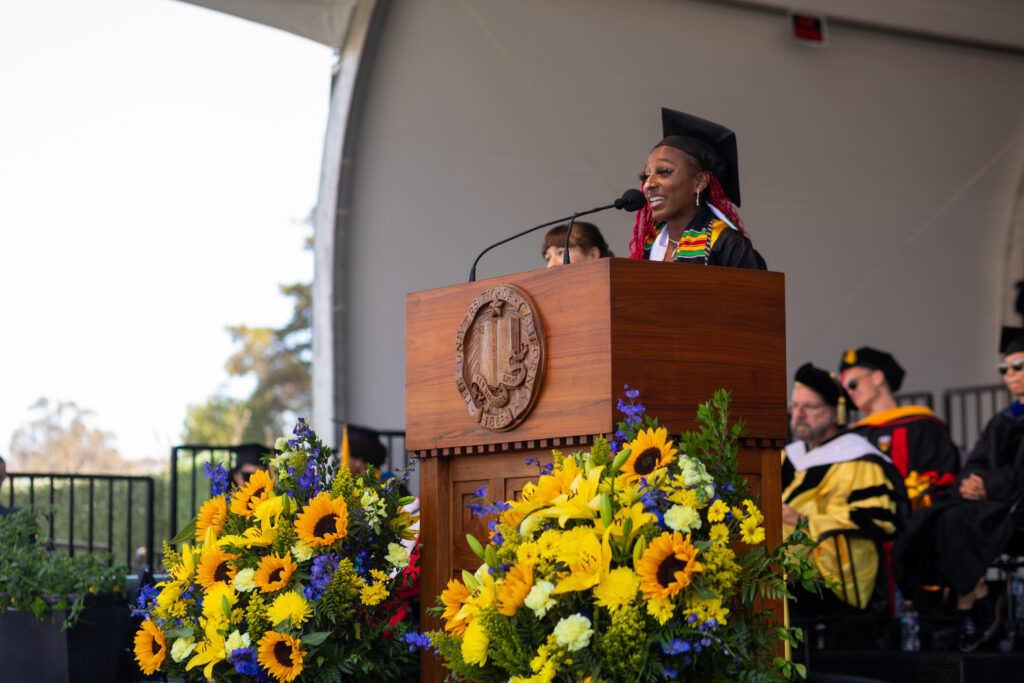
In response to a strong culture of Black student activism, the Office of Black Student Development advances the experiences of Black students, advocates for their needs, and fosters their personal and academic success through graduation and beyond. Through the development of innovative and sustainable programs and services, OBSD supports the recruitment, retention, academic achievement, holistic well-being, and self-advocacy of the Black student community. The office plays a critical role in addressing student needs while advancing institutional accountability and fostering a campus environment that promotes inclusion, belonging, and leadership for social change.
OBSD reflects a sustained history of student advocacy at UC Santa Barbara and represents the university’s commitment to supporting Black students. Informed by the work of multiple generations of Black Student Union Demands Teams, the office is both grounded in this legacy and positioned to support and develop future student leaders. OBSD serves as a vital space for connection, engagement, and leadership within the campus community.
OBSD Programs
- Black Student Leadership Retreat
- Forward Ever Backward Never
- Vision Fellowship
- Black History Month Opening Ceremony
- Black Community Forums
- Black Grad Celebration
- Black Week of Welcome
Divisional Leadership

Suzanne Perkin
Suzanne Perkin, a Southern California native, has dedicated her career to higher education, primarily within the University of California system. A UCSB alumna, she attributes her success as a student to early and sustained campus involvement, including roles as a campus tour guide, Orientation leader and supervisor, and staff member in the Disabled Students Program. In her current role, Perkin oversees programs and services that foster student connection, engagement, and a sense of belonging across the university.

Joaquin Becerra
Joaquin Becerra, a Mexican immigrant and first-generation college graduate, was raised in Brawley, California. Throughout his career, he has demonstrated a strong commitment to supporting marginalized communities and advancing student success. As a UCSB alumnus who navigated his college experience with limited guidance, Becerra brings a deeply personal and professional commitment to improving the student experience. He oversees departments within the Student Life and Belonging cluster and works closely with cultural resource centers to address campus climate and strengthen community engagement. As dean of students, he serves as a liaison between students and university leadership, elevating student perspectives and advocating for their needs. The director of OBSD reports to Becerra.
Student Life Organizational Chart
Institutional Overview
The University of California, Santa Barbara, is a public land-grant research institution. Tracing its roots to 1890 as an independent teacher’s college, UC Santa Barbara joined the prestigious University of California system in 1944 as its third-oldest undergraduate campus. As a leading research institution offering a comprehensive liberal arts education, UC Santa Barbara welcomes approximately 26,000 undergraduate and graduate students each year to its beautiful oceanside campus. The university is regarded as a “Public Ivy” institution and is a member of the Association of American Universities (AAU).
Mission and Overview of UC Santa Barbara

The Student Body
Total Enrollment: 26,068
Undergraduate: 23,232
Graduate: 2,836
Male: 43.9%
Female: 56.1%
African American/Black: 4.2%
Asian: 17.9%
Hispanic/Latino: 24.5%
White: 32.1%
Two or More Races: 8%
Unknown: 2.5%
Non-Resident: 10.8%
Institutional Leadership

Dennis Assanis
Dennis Assanis is the sixth chancellor of the University of California, Santa Barbara. He previously served as the president of the University of Delaware from 2016 to 2025.
Dennis Assanis is the sixth chancellor of the University of California, Santa Barbara. He previously served as president of the University of Delaware from 2016 to 2025.
Before joining the University of Delaware, Assanis served as provost and senior vice president for academic affairs at Stony Brook University and as vice president for Brookhaven National Laboratory affairs. He also taught and conducted research at the University of Michigan and the University of Illinois at Urbana–Champaign.
Born and raised in Athens, Greece, Assanis earned a bachelor’s degree in marine engineering from Newcastle University in England in 1980. At the Massachusetts Institute of Technology, he earned three master’s degrees—in naval architecture and marine engineering and in mechanical engineering (both in 1982), and in management (1986)—as well as a PhD in power and propulsion (1985). He received an honorary doctor of humane letters from the University of Delaware in 2025.
Chancellor’s Organizational Chart

Benefits Overview
Working at UCSB means being part of a vibrant institution that shines a light on what is possible. Excellent retirement and health benefits are just some of the rewards offered by the university. Learn more about the benefits of working at UCSB.
Application
To ensure full consideration, interested individuals should submit materials by the priority deadline of May 6, 2026. To apply for this position, please click on the Apply button, complete the brief application process, and upload your resume and position-specific cover letter. Applicants needing reasonable accommodation to participate in the application process should contact Spelman Johnson at 413-529-2895 or email info@spelmanjohnson.com.
Visit the University of California, Santa Barbara website at https://www.ucsb.edu/
UC Vaccination Programs Policy:
As a condition of employment, you will be required to comply with the University of California Policy on Vaccinations Programs.
As a condition of Physical Presence at a Location or in a University Program, all Covered Individuals* must participate in any applicable Vaccination Program by providing proof that they are Up-to-Date with any required Vaccines or submitting a request for Exception in a Mandate Program or properly declining vaccination in an Opt-Out Program no later than the Compliance Date (Capitalized terms in this paragraph are defined in the policy.). Federal, state, or local public health directives may impose additional requirements.
For more information, please visit the University of California Policy on Vaccinations – https://policy.ucop.edu/doc/5000695/VaccinationProgramsPolicy.
*Covered Individuals: A Covered Individual includes anyone designated as Personnel or Students under this Policy who physically access a University Facility or Program in connection with their employment, appointment, or education/training.
Misconduct Disclosure Requirement:
Misconduct Disclosure Requirement: As a condition of employment, the final candidate who accepts an offer of employment will be required to disclose if they have been subject to any final administrative or judicial decisions within the last seven years determining that they committed any misconduct; or have filed an appeal of a finding of substantiated misconduct with a previous employer.
“Misconduct” means any violation of the policies governing employee conduct at the applicant’s previous place of employment, including, but not limited to, violations of policies prohibiting sexual harassment, sexual assault, or other forms of harassment, or discrimination, as defined by the employer. For reference, below are UC’s policies addressing some forms of misconduct:
- UC Sexual Violence and Sexual Harassment Policy
- UC Anti-Discrimination Policy
- Abusive Conduct in the Workplace
UC Santa Barbara is an Equal Opportunity/Affirmative Action Employer and all qualified applicants will receive consideration for employment without regard to race, color, religion, sex, sexual orientation, gender identity, national origin, disability status, protected veteran status, or any other characteristic protected by law.
RELATED LINKS:
About Santa Barbara, California